SHARE NOW
19 Dec 2025 - SEATRADE CRUISE REVIEW
SEATRADE CRUISE REVIEW
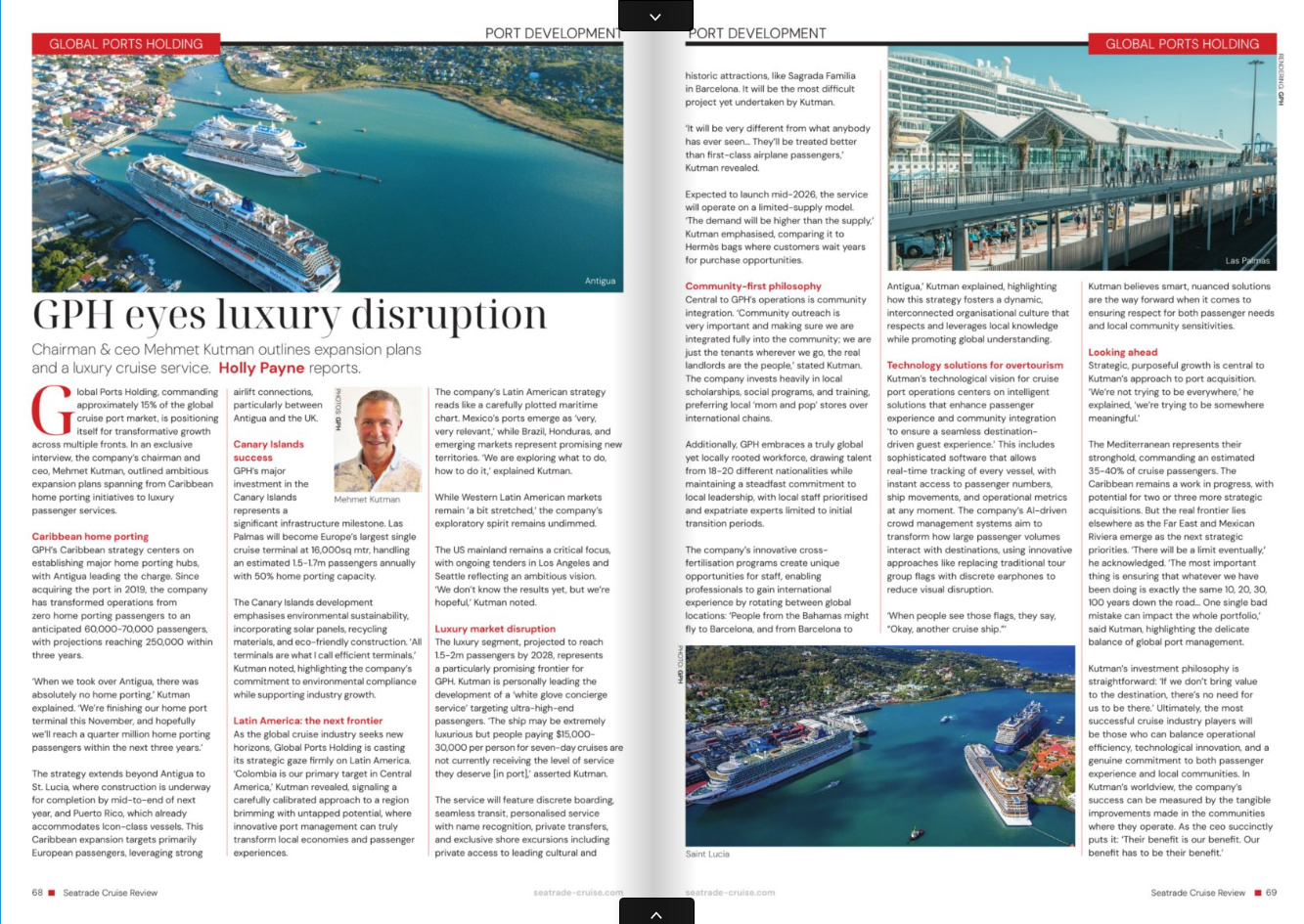
Global Ports Holding, commanding approximately 15% of the global cruise port market, is positioning itself for transformative growth across multiple fronts. In an exclusive interview, the company’s chairman and CEO, Mehmet Kutman, outlined ambitious expansion plans spanning from Caribbean home porting initiatives to luxury passenger services.
Caribbean home porting
GPH’s Caribbean strategy centers on establishing major home porting hubs, with Antigua leading the charge. Since acquiring the port in 2019, the company has transformed operations from zero home porting passengers to an anticipated 60,000–70,000 passengers, with projections reaching 250,000 within three years.
‘When we took over Antigua, there was absolutely no home porting,’ Kutman explained. ‘We’re finishing our home port terminal this November, and hopefully we’ll reach a quarter million home porting passengers within the next three years.’
The strategy extends beyond Antigua to St. Lucia, where construction is underway for completion by mid-to-end of next year, and Puerto Rico, which already accommodates Icon-class vessels. This Caribbean expansion targets primarily European passengers, leveraging strong airlift connections, particularly between Antigua and the UK.
Canary Islands success
GPH’s major investment in the Canary Islands represents a significant infrastructure milestone. Las Palmas will become Europe’s largest single cruise terminal at 16,000sq mtr, handling an estimated 1.5–1.7m passengers annually with 50% home porting capacity.
The Canary Islands development emphasizes environmental sustainability, incorporating solar panels, recycling materials, and eco-friendly construction. ‘All terminals are what I call efficient terminals,’ Kutman noted, highlighting the company’s commitment to environmental compliance while supporting industry growth.
Latin America: the next frontier
As the global cruise industry seeks new horizons, Global Ports Holding is casting its strategic gaze firmly on Latin America. ‘Colombia is our primary target in Central America,’ Kutman revealed, signalling a carefully calibrated approach to a region brimming with untapped potential, where innovative port management can truly transform local economies and passenger experiences.
The company’s Latin American strategy reads like a carefully plotted maritime chart. Mexico’s ports emerge as ‘very, very relevant,’ while Brazil, Honduras, and emerging markets represent promising new territories. ‘We are exploring what to do, how to do it,’ explained Kutman.
While Western Latin American markets remain ‘a bit stretched,’ the company’s exploratory spirit remains undimmed.
The US mainland remains a critical focus, with ongoing tenders in Los Angeles and Seattle reflecting an ambitious vision. ‘We don’t know the results yet, but we’re hopeful,’ Kutman noted.
Luxury market disruption
The luxury segment, projected to reach 1.5–2m passengers by 2028, represents a particularly promising frontier for GPH. Kutman is personally leading the development of a ‘white glove concierge service’ targeting ultra-high-end passengers. ‘The ship may be extremely luxurious but people paying $15,000–30,000 per person for seven-day cruises are not currently receiving the level of service they deserve [in port],’ asserted Kutman.
The service will feature discrete boarding, seamless transit, personalised service with name recognition, private transfers, and exclusive shore excursions including private access to leading cultural and historic attractions, like Sagrada Familia in Barcelona. It will be the most difficult project yet undertaken by Kutman.
‘It will be very different from what anybody has ever seen.. They’ll be treated better than first-class airplane passengers,’ Kutman revealed.
Expected to launch mid-2026, the service will operate on a limited-supply model. ‘The demand will be higher than the supply,’ Kutman emphasised, comparing it to Hermès bags where customers wait years for purchase opportunities.
Community-first philosophy
Central to GPH’s operations is community integration. ‘Community outreach is very important and making sure we are integrated fully into the community; we are just the tenants wherever we go, the real landlords are the people,’ stated Kutman. The company invests heavily in local scholarships, social programs, and training, preferring local ‘mom and pop’ stores over international chains.
Additionally, GPH embraces a truly global yet locally rooted workforce, drawing talent from 18–20 different nationalities while maintaining a steadfast commitment to local leadership, with local staff prioritised and expatriate experts limited to initial transition periods.
The company’s innovative cross-fertilisation programs create unique opportunities for staff, enabling professionals to gain international experience by rotating between global locations: ‘People from the Bahamas might fly to Barcelona, and from Barcelona to Antigua,’ Kutman explained, highlighting how this strategy fosters a dynamic, interconnected organisational culture that respects and leverages local knowledge while promoting global understanding.
Technology solutions for overtourism
Kutman’s technological vision for cruise port operations centers on intelligent solutions that enhance passenger experience and community integration ‘to ensure a seamless destination-driven guest experience.’ This includes sophisticated software that allows real-time tracking of every vessel, with instant access to passenger numbers, ship movements, and operational metrics at any moment. The company’s AI-driven crowd management systems aim to transform how large passenger volumes interact with destinations, using innovative approaches like replacing traditional tour group flags with discrete earphones to reduce visual disruption.
‘When people see those flags, they say, “Okay, another cruise ship.”’
Kutman believes smart, nuanced solutions are the way forward when it comes to ensuring respect for both passenger needs and local community sensitivities.
Looking ahead
Strategic, purposeful growth is central to Kutman’s approach to port acquisition. ‘We’re not trying to be everywhere,’ he explained, ‘we’re trying to be somewhere meaningful’.
The Mediterranean represents their stronghold, commanding an estimated 35–40% of cruise passengers. The Caribbean remains a work in progress, with potential for two or three more strategic acquisitions. But the real frontier lies elsewhere as the Far East and Mexican Riviera emerge as the next strategic priorities. ‘There will be a limit eventually,’ he acknowledged. ‘The most important thing is ensuring that whatever we have been doing is exactly the same 10, 20, 30, 100 years down the road.. One single bad mistake can impact the whole portfolio,’ said Kutman, highlighting the delicate balance of global port management.
Kutman’s investment philosophy is straightforward: ‘If we don’t bring value to the destination, there’s no need for us to be there.’ Ultimately, the most successful cruise industry players will be those who can balance operational efficiency, technological innovation, and a genuine commitment to both passenger experience and local communities. In Kutman’s worldview, the company’s success can be measured by the tangible improvements made in the communities where they operate. As the CEO succinctly puts it: ‘Their benefit is our benefit. Our benefit has to be their benefit.’
19 Dec 2025
SEATRADE CRUISE REVIEW
Global Ports Holding, commanding approximately 15% of the global cruise port market, is positioning itself for transformative growth across multiple fronts. In an exclusive interview, the company’s chairman and CEO, Mehmet Kutman, outlined ambitious expansion plans spanning from Caribbean home porting initiatives to luxury passenger services.
Caribbean home porting
GPH’s Caribbean strategy centers on establishing major home porting hubs, with Antigua leading the charge. Since acquiring the port in 2019, the company has transformed operations from zero home porting passengers to an anticipated 60,000–70,000 passengers, with projections reaching 250,000 within three years.
‘When we took over Antigua, there was absolutely no home porting,’ Kutman explained. ‘We’re finishing our home port terminal this November, and hopefully we’ll reach a quarter million home porting passengers within the next three years.’
The strategy extends beyond Antigua to St. Lucia, where construction is underway for completion by mid-to-end of next year, and Puerto Rico, which already accommodates Icon-class vessels. This Caribbean expansion targets primarily European passengers, leveraging strong airlift connections, particularly between Antigua and the UK.
Canary Islands success
GPH’s major investment in the Canary Islands represents a significant infrastructure milestone. Las Palmas will become Europe’s largest single cruise terminal at 16,000sq mtr, handling an estimated 1.5–1.7m passengers annually with 50% home porting capacity.
The Canary Islands development emphasizes environmental sustainability, incorporating solar panels, recycling materials, and eco-friendly construction. ‘All terminals are what I call efficient terminals,’ Kutman noted, highlighting the company’s commitment to environmental compliance while supporting industry growth.
Latin America: the next frontier
As the global cruise industry seeks new horizons, Global Ports Holding is casting its strategic gaze firmly on Latin America. ‘Colombia is our primary target in Central America,’ Kutman revealed, signalling a carefully calibrated approach to a region brimming with untapped potential, where innovative port management can truly transform local economies and passenger experiences.
The company’s Latin American strategy reads like a carefully plotted maritime chart. Mexico’s ports emerge as ‘very, very relevant,’ while Brazil, Honduras, and emerging markets represent promising new territories. ‘We are exploring what to do, how to do it,’ explained Kutman.
While Western Latin American markets remain ‘a bit stretched,’ the company’s exploratory spirit remains undimmed.
The US mainland remains a critical focus, with ongoing tenders in Los Angeles and Seattle reflecting an ambitious vision. ‘We don’t know the results yet, but we’re hopeful,’ Kutman noted.
Luxury market disruption
The luxury segment, projected to reach 1.5–2m passengers by 2028, represents a particularly promising frontier for GPH. Kutman is personally leading the development of a ‘white glove concierge service’ targeting ultra-high-end passengers. ‘The ship may be extremely luxurious but people paying $15,000–30,000 per person for seven-day cruises are not currently receiving the level of service they deserve [in port],’ asserted Kutman.
The service will feature discrete boarding, seamless transit, personalised service with name recognition, private transfers, and exclusive shore excursions including private access to leading cultural and historic attractions, like Sagrada Familia in Barcelona. It will be the most difficult project yet undertaken by Kutman.
‘It will be very different from what anybody has ever seen.. They’ll be treated better than first-class airplane passengers,’ Kutman revealed.
Expected to launch mid-2026, the service will operate on a limited-supply model. ‘The demand will be higher than the supply,’ Kutman emphasised, comparing it to Hermès bags where customers wait years for purchase opportunities.
Community-first philosophy
Central to GPH’s operations is community integration. ‘Community outreach is very important and making sure we are integrated fully into the community; we are just the tenants wherever we go, the real landlords are the people,’ stated Kutman. The company invests heavily in local scholarships, social programs, and training, preferring local ‘mom and pop’ stores over international chains.
Additionally, GPH embraces a truly global yet locally rooted workforce, drawing talent from 18–20 different nationalities while maintaining a steadfast commitment to local leadership, with local staff prioritised and expatriate experts limited to initial transition periods.
The company’s innovative cross-fertilisation programs create unique opportunities for staff, enabling professionals to gain international experience by rotating between global locations: ‘People from the Bahamas might fly to Barcelona, and from Barcelona to Antigua,’ Kutman explained, highlighting how this strategy fosters a dynamic, interconnected organisational culture that respects and leverages local knowledge while promoting global understanding.
Technology solutions for overtourism
Kutman’s technological vision for cruise port operations centers on intelligent solutions that enhance passenger experience and community integration ‘to ensure a seamless destination-driven guest experience.’ This includes sophisticated software that allows real-time tracking of every vessel, with instant access to passenger numbers, ship movements, and operational metrics at any moment. The company’s AI-driven crowd management systems aim to transform how large passenger volumes interact with destinations, using innovative approaches like replacing traditional tour group flags with discrete earphones to reduce visual disruption.
‘When people see those flags, they say, “Okay, another cruise ship.”’
Kutman believes smart, nuanced solutions are the way forward when it comes to ensuring respect for both passenger needs and local community sensitivities.
Looking ahead
Strategic, purposeful growth is central to Kutman’s approach to port acquisition. ‘We’re not trying to be everywhere,’ he explained, ‘we’re trying to be somewhere meaningful’.
The Mediterranean represents their stronghold, commanding an estimated 35–40% of cruise passengers. The Caribbean remains a work in progress, with potential for two or three more strategic acquisitions. But the real frontier lies elsewhere as the Far East and Mexican Riviera emerge as the next strategic priorities. ‘There will be a limit eventually,’ he acknowledged. ‘The most important thing is ensuring that whatever we have been doing is exactly the same 10, 20, 30, 100 years down the road.. One single bad mistake can impact the whole portfolio,’ said Kutman, highlighting the delicate balance of global port management.
Kutman’s investment philosophy is straightforward: ‘If we don’t bring value to the destination, there’s no need for us to be there.’ Ultimately, the most successful cruise industry players will be those who can balance operational efficiency, technological innovation, and a genuine commitment to both passenger experience and local communities. In Kutman’s worldview, the company’s success can be measured by the tangible improvements made in the communities where they operate. As the CEO succinctly puts it: ‘Their benefit is our benefit. Our benefit has to be their benefit.’